It portrays this native bird, once common in the Pampas, as a weave: a collective identity, a thicket where four bodies merge and necks and legs intertwine.
Nadia Guthmann
I have always been interested in living beings, so much so that I took a doctorate in biology without ever ceasing to express myself artistically. Working with metal mesh, biological and sculptural concepts converged to think and feel that they are, precisely, in the multiple forms of the living where the human condition is also developed and realized. The metal meshes refer to biological tissues, the skin, the interface between the self and the other, between interior and exterior. But transparency, the fusion of bodies or the inclusion of an animal within another, breaks the idea of individuality and suggests another type of unity: systems. The separation between one and the other is not absolute, the limits are permeable, the boundaries are intertwined, bodies and territories are mixed, identities are intertwined and different worlds that interact coexist, an interior and an exterior whose boundaries are crossed.
 1 / 7
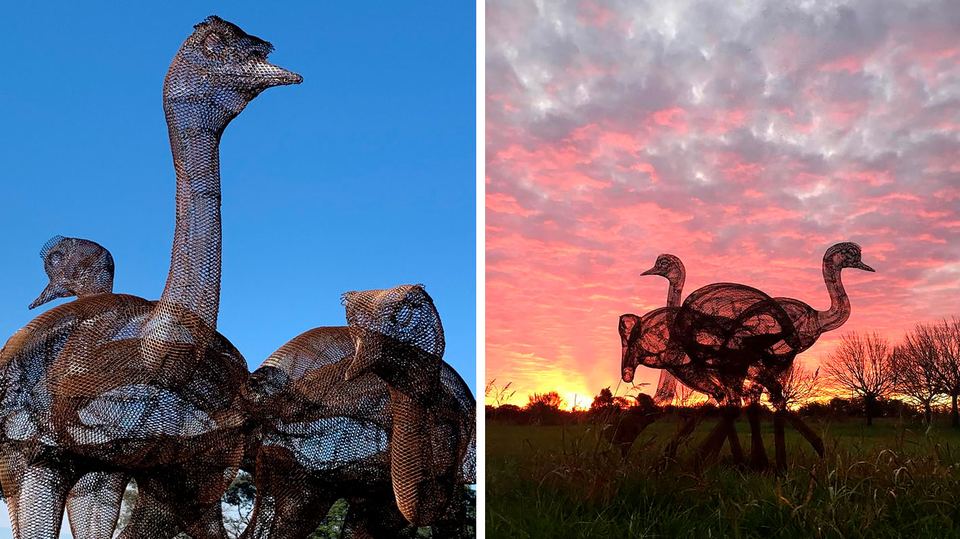
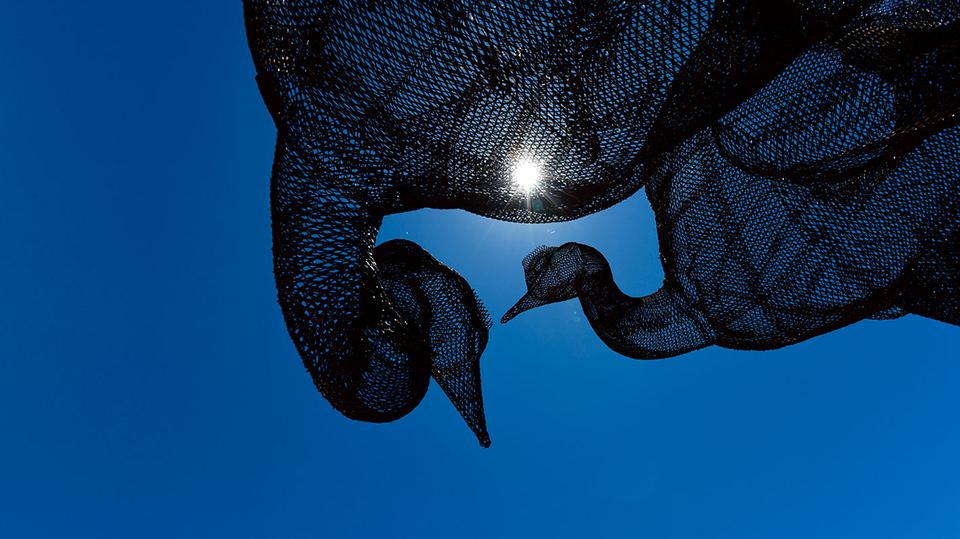
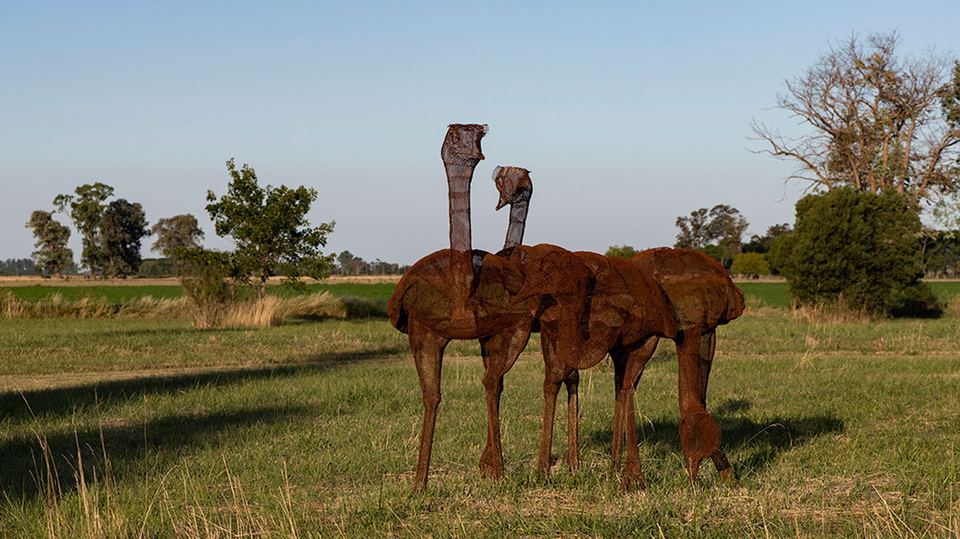
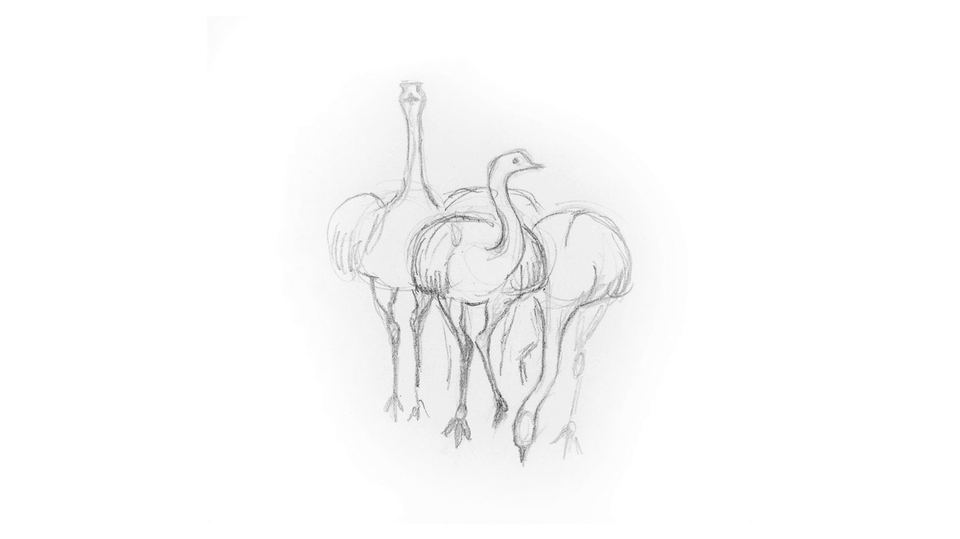
RheasNadia Guthmann · Expanded metal mesh · Sculpture
It portrays this native bird, once common in the Pampas, as a weave: a collective identity, a thicket where four bodies merge and necks and legs intertwine.
Teyú GuyráNadia Guthmann · Expanded metal mesh · Sculpture
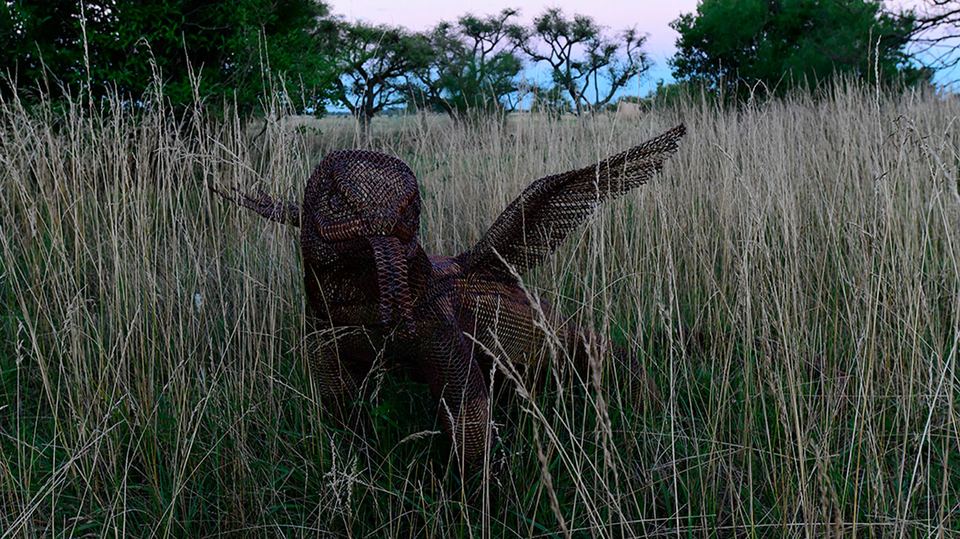
A chimera of tegu lizard and bird of prey, able to crawl and fly at the same time: it slips into burrows and moves through the grassland, and at once lifts off the ground and lightly conquers the air.
Spirits in the WindNadia Guthmann · Expanded metal mesh · Sculpture
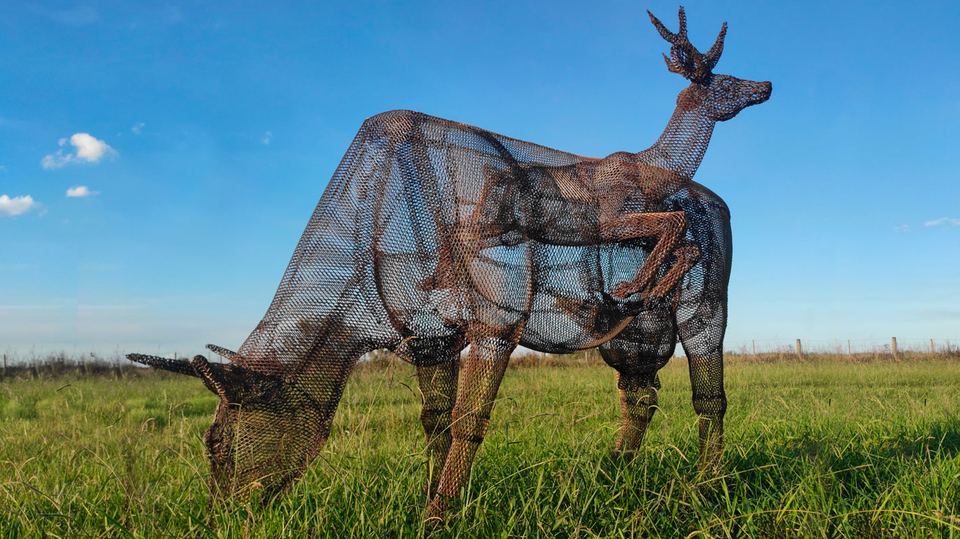
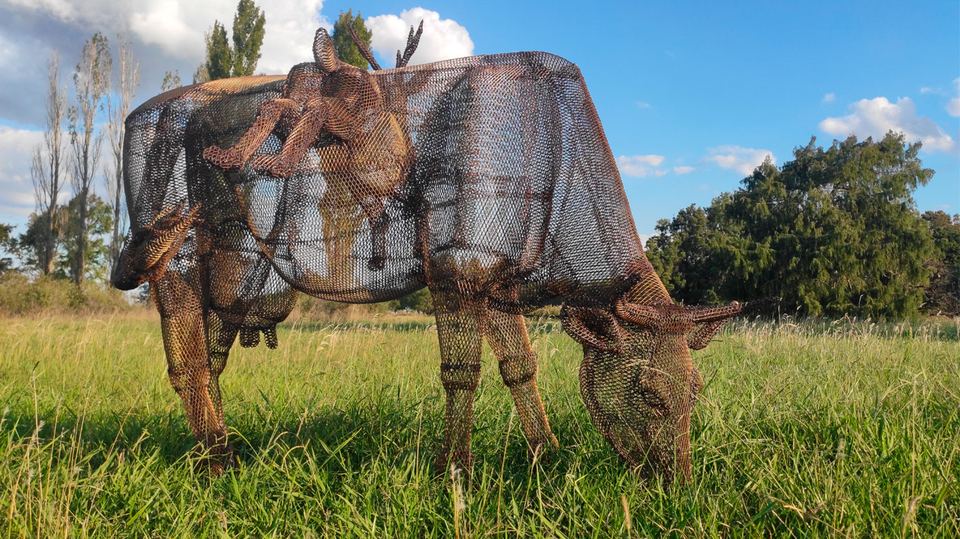
It brings into the present of Bellatrix creatures that lived on this land at different times in the past: Pampas deer and cows. Like the wind that crosses the plains without limits or borders, their memories pass through us.
Works at Bellatrix
A chimera of tegu lizard and bird of prey, able to crawl and fly at the same time: it slips into burrows and moves through the grassland, and at once lifts off the ground and lightly conquers the air.
It brings into the present of Bellatrix creatures that lived on this land at different times in the past: Pampas deer and cows. Like the wind that crosses the plains without limits or borders, their memories pass through us.
Standing before Teyú Guyrá, Espíritus en el viento (Spirits in the Wind) and the Ñandúes (Rheas), we face a biological and artistic event in which we grasp not only an ecological vision and an appreciation of living beings, but also Nadia’s complete artistic mastery. She works on the shores of Lake Gutiérrez, with wonderful views, surrounded by trees, in a place where inspiration arises naturally. Nadia makes sculptures out of a sense of exploration, creativity and imagination. As a PhD in Biology, she understands the concepts of ecology and evolution precisely.
In her works we can draw parallels with society: her animals speak of biology, but at the same time they speak of human relationships.
Her work with expanded metal lets us perceive more air than matter, which creates a translucent effect, an interplay of light and the landscape behind. The porosity of her works thus highlights the connection with the place, with the land, with Bellatrix and its starry countryside. Her animals come to life at Bellatrix and blend into the landscape. On her visits to our space we have always noticed the immense joy that characterizes her, her eagerness to share, and her passion for sculpture and animals.
In the artist’s words
“I found in Bellatrix a kindred, inspiring place to create and to inhabit with my sculptures, to draw in the air with metal mesh and trace in its sky the roots of life on earth, to inhabit it again with the species that were displaced, and to rediscover with them forgotten aspects of ourselves.”
“I have been working with metal mesh for many years. I started with softer materials, plasterers’ expanded mesh and wire cloth, and applied what I had learned about how the material behaves to this harder material, expanded metal: cutting it, hammering it. And from the moment I started with this material, a series of works emerged, images of animals one inside another. The mesh defines an animal, but once you put one inside another it becomes a system. I play a lot with that: since I am a biologist and have also worked in ecology, all this knowledge of biology, ecology and evolution comes together with sculptural concepts. So I am talking about systems.”
“Teyú Guyrá is a chimera of a tegu lizard and a bird of prey. It can crawl and fly at the same time: it can slip into burrows and move through the grassland in contact with the earth, and also lift off the ground and conquer the air with lightness. It reminds us that we stand on what is concrete and material, while an intangible world sustains our creativity.”
“Espíritus en el viento brings into Bellatrix’s present some beings that inhabited the countryside at different moments in the past: Pampas deer and cows. Like the wind that sweeps across the Pampas without respecting limits or borders, their memories caress us, pass through us, and whisper reflections on a habitat that is transformed and full of life.”
“Ñandúes portrays this native bird, once common in the Pampas region, as a web, a collective identity, like a thicket where four bodies merge and necks and legs intertwine, where the animal blends with the plant in the way it grows and occupies space.”
Biography
I was born in Buenos Aires in 1964 and, having just turned 12, moved to Bariloche. From a very young age I was interested in nature, ecology and evolution, in living beings, and I felt a deep empathy for animals in particular. I related to these subjects with both hemispheres of the brain: reading and thinking, contemplating and experiencing, drawing and making sculptures. Mountaineering was central in my teenage years, giving me the contact with nature I longed for and also a way to escape the oppressive and repressive atmosphere of our country at that time.
I studied Biology at the Universidad Nacional del Comahue and earned my PhD in 1998 with a Conicet fellowship. At the same time I kept drawing and making sculptures, learning some techniques in local artists’ workshops and in short courses taught by artists who came from other cities. Bariloche did not offer many opportunities to take courses or see art exhibitions, and I made up for it a little whenever I could travel to Buenos Aires, sometimes with the help of grants such as those from the Río Negro Undersecretariat of Culture in 1989 and the Fundación Trabucco in 2005. I went not only to visual arts exhibitions but also to theater, dance, film and concerts. In 1999 I was a fellow in the Training Program for Artists from the Interior, held in Bariloche. More recently, it was stimulating to take part in Entrecampos Regional in General Roca and in Rosario in 2008.
I had started exhibiting and sending sculptures to regional competitions in 1983. In 1996 I won First Prize at the XIII Annual Art Salon of the Fundación Bolsa de Comercio de Bahía Blanca with one of my first works in wire cloth, which brought together biological and sculptural concepts. In 2003 I won First Prize at the XII Río Negro Art Salon in Bariloche. That same year I was selected to take part for the first time in an exhibition in Buenos Aires: Estudio Abierto, in the former Harrods store. I was then invited to take part in Naturaleza Artificial at La Casona de los Olivera. In 2005 the Centro Cultural Recoleta hosted the Río Negro Art exhibition within the Argentina Pinta Bien program. Since I had work in Buenos Aires and the dates coincided, I entered the National Salon at the Palais de Glace. Receiving an Honorable Mention encouraged me to keep entering, and the following year I received Third Prize. I also began sending work to the Salón Manuel Belgrano at the Museo Sívori, where I received a Mention in 2005. In those years the city of Cipolletti, Río Negro, organized the only National Salon of Visual Arts in my region, where I received a Mention in 2006 and Second Prize in 2008.
Source: boladenieve.org.ar