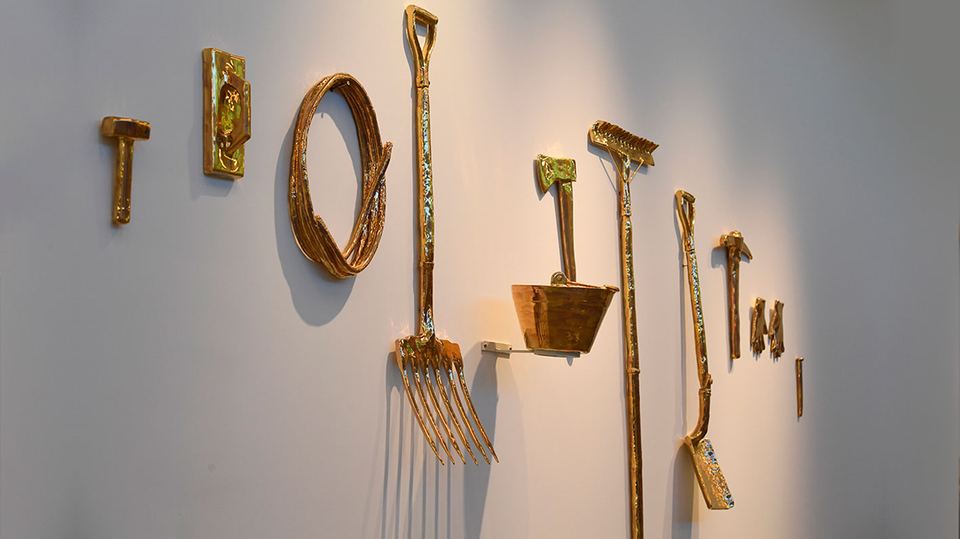
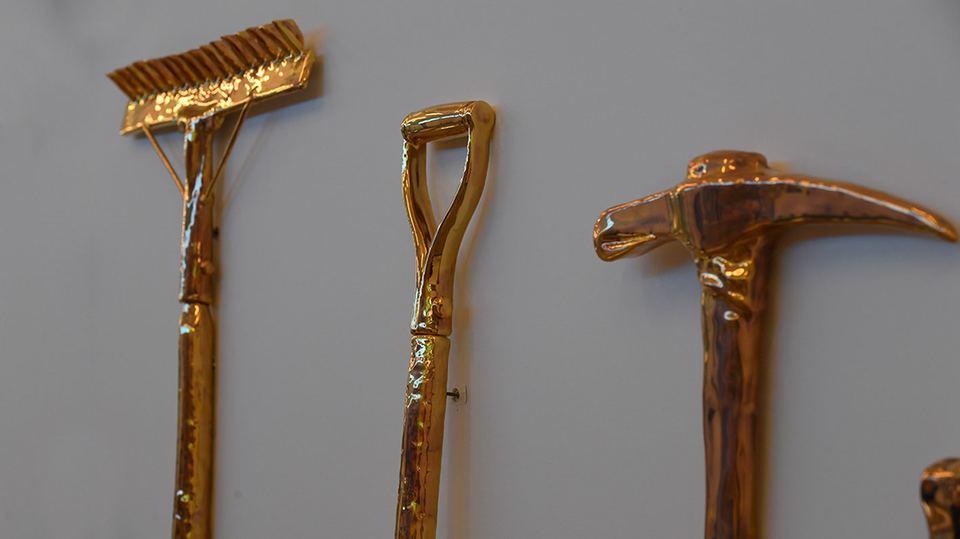
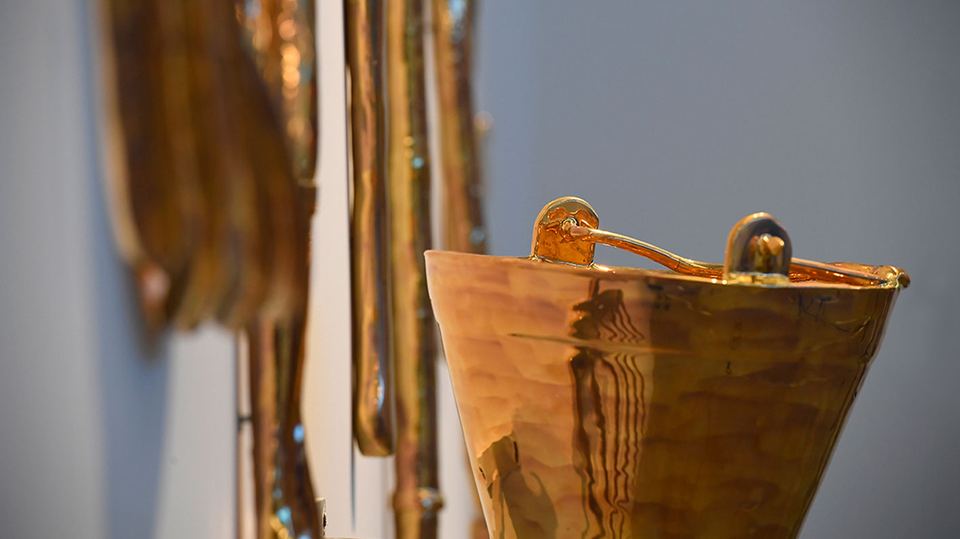
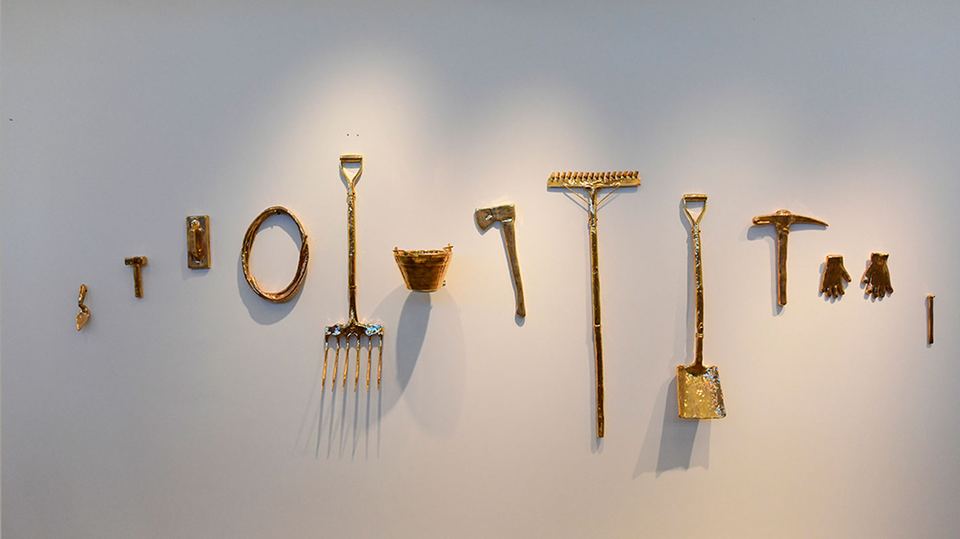
A set of tools cast from the ones the artist used in the video performance “La tarea” (The Task), in which he learned to build an adobe house with his own hands alongside a master builder.
Gabriel Baggio
In an increasingly specialized and mediatized world, I find in the manual laboriousness of certain trades alternatives that, when practiced, develop and amplify bonds. It is a way of resisting the rigid processes of mercantilization. It is not a question of new forms of economy or anti-capitalist organizations but of redeeming the potentiality that still lies, hidden, in certain things that seem dead or obsolete.
 1 / 7

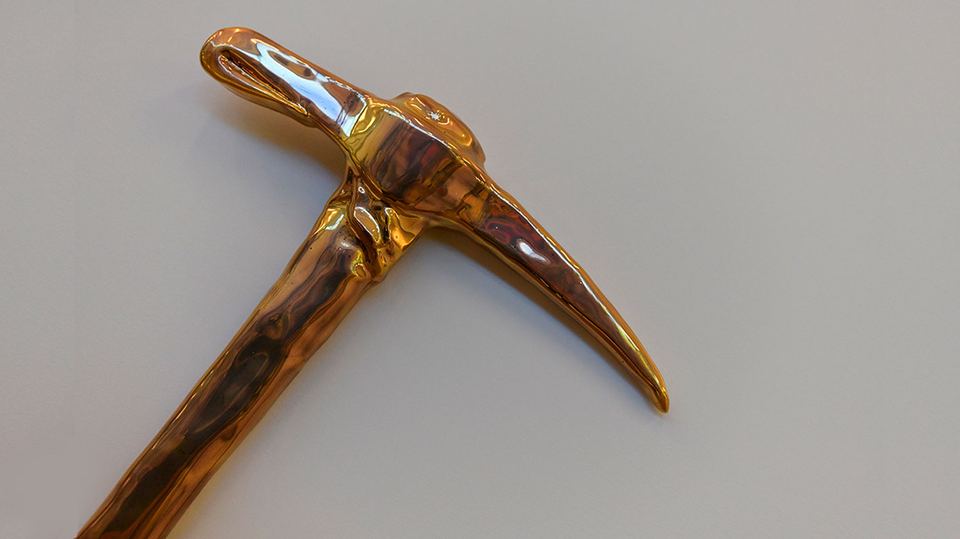
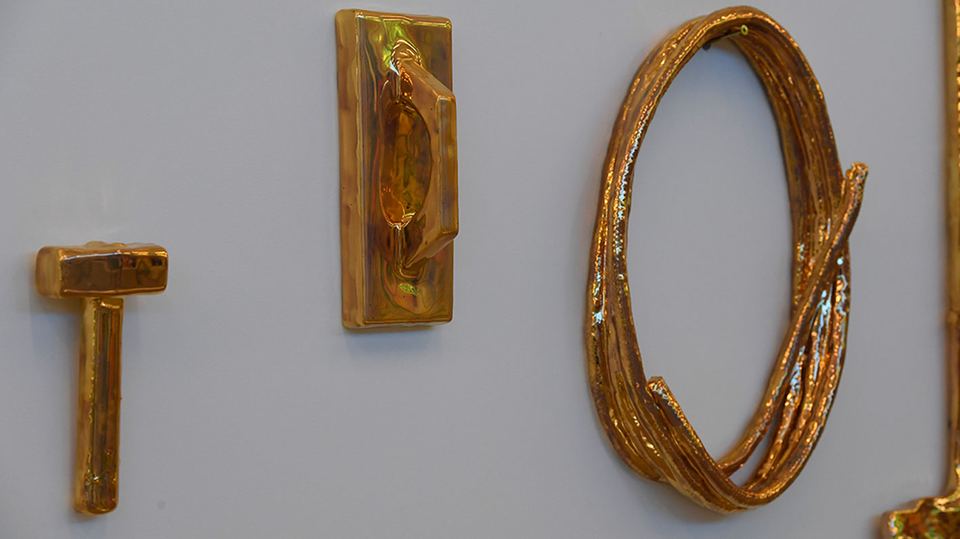
The Pampa Is Seen from WithinGabriel Baggio
A set of tools cast from the ones the artist used in the video performance “La tarea” (The Task), in which he learned to build an adobe house with his own hands alongside a master builder.
Works at Bellatrix
Gabriel Baggio learns crafts for his performances, from knitting a 50-meter scarf to cooking a family soup recipe with his mother and grandmother. He is interested in exploring the crafts that are handed down from one generation to the next: knowledge passed on from master to apprentice.
In his performances he builds a bond and a sense of intimacy with his working partners. He wants a real learning process to take place during the performance, with little prior practice.
His work is highly significant because in “La tarea” (The Task) the artist built an adobe house with his own hands, helped by a master builder, something unusual for a sculptor. The tools we see in the Gallery, which together make up “La pampa se ve desde adentro” (The Pampas Seen from Within), are casts of the tools he used in that process.
Critical views on his work
“The variety of formats, techniques and resources Baggio uses, ranging from videos of his performances to painting, ceramics or marquetry, does not hide the intense conceptual unity of his work. On the contrary, it enriches it, because it reveals the density of overlapping meanings that interact within that unity. There is the idea that the places and objects of everyday life carry a certain charge of mystery. The kitchen and the master craftsman’s workshop are places where ordinary people handle tools and materials to produce small miracles. At what moment, and in what way, do a few simple ingredients turn into something else, something as different as a meal that will be remembered for the rest of one’s life? Much of Baggio’s work comes from probing those mysteries in an attempt to decode them. There are also memories, tools, learning processes, masters and searches. And at the same time, there is the integration into a world, that of craftsmanship, marked by ritual, the repetition of gestures, and the combination of personal creativity with a practice based on reproducing an ancestral model.”
Source: arte-online.net
“From his close, familiar world, Baggio asks about the emotional and material ties present in processes of continuity and transformation. He tries to account for the presence of some images within others, understanding that such traces are evidence of contact, testimony of bonds and closeness. These clues set texts, objects, practices and knowledge in sequence, and reveal something of the dense networks in which family and social culture is formed. In his ceramic objects, he reconstructs the ancient cultural scene that today appears broken, scattered and unrecognizable.”
Source: F. Baeza
His thoughts on Bellatrix
A space designed to enjoy works of art in a natural, specifically Pampean setting: without a doubt, the specific and the small singularities are the doors through which I approach my concerns. The immense plain and its political and geographical features are what drive these works, and being able to see them in that setting gives them an extremely relevant context.
In an increasingly specialized and mediated world, I find in the manual labor of certain crafts alternatives that, when practiced, develop and expand our bonds. It is a way of resisting rigid processes of commodification. It is not about new forms of economy or anti-capitalist organizations, but about redeeming the potential that still lies hidden in certain things that seem dead or obsolete. It is about pointing to alternative ways of existing that can counter the speed and anomie of the dominant culture. To reason about history is, inseparably, to reason about power structures, so that time does not cancel out human effort.
The work “La pampa se ve desde adentro” comes from casts of the tools used in the video performance “La tarea”. In that action I learned to build an adobe house, and the whole learning process, at the end of which the house was actually built, was filmed in real time in a video about 150 hours long.
In the artist’s words
“Amid globalization and the homogenization of life in general, I am interested in the specificity of those practices. I think that I, and many other people, can be interested in how someone built their house with the very earth they had nearby and made themselves a shelter that serves perfectly to live in. Or how someone fixed a pot instead of buying a new one, and rebuilt its handle. I, at least, am interested. If you are immersed in immediacy, in the contemporary whirlwind, an experience like that challenges you more than the act of buying a new utensil to replace the broken one. The experience of intersubjective contact brings us closer to common sense, and that helps us move away from the numbness that consumption produces. Collective thinking is the opposite of the ambitions of capitalism. I trust in experience as a way to break free from contemporary apathy.”
On his performances: “Intimacy is something you have to build. The relationships usually begin long before the performance takes place, when I start building the bond with the other person. In general, the masters want the performance to happen after I have practiced the craft at least a little, but my idea is really to learn in the moment. For that to happen, there has to be a bond that precedes the artistic situation. In the performance Conversación (Conversation), I do face the unexpected in terms of relationships, and for that I always have strategies: I set out biscuits I bake myself, wine, glasses and all sorts of decoration to try to hasten that moment of intimacy, when people manage to feel comfortable and give themselves over to the moment.”
Biography
Born in Buenos Aires in 1974, where he lives and works. National Teacher of Drawing and Painting, Escuela Nacional de Bellas Artes Prilidiano Pueyrredón, 1998.
Solo exhibitions
- Elogio de la profanación. Fundación Klemm. Buenos Aires. 2011
- Catálogo. Insight Arte. Buenos Aires. 2008 / Juana de Arco. Buenos Aires. 2007
- La razón del gourmet. Shop-window intervention at CCEBA. 2007
- Apologies for the inconvenience, cleaning in Progress. HKIAW. Wan Chai, Hong Kong, China. 2005
- Tu memoria termina justo donde empieza la mía. Irish Museum of Modern Art, Dublin / Galería Proyecto A. Buenos Aires. 2004.
- Nieto. Installed in his grandmother’s house. Proyecto A. Buenos Aires. 2002.
- Gula. La Casona de los Olivera. Buenos Aires. 2001.
Performances (selection)
- Remera de algodón. Sala Ezequiel Linares, Tucumán, 2011.
- Rosa en marquetería. Museo de Arte Moderno de Buenos Aires. 2010
- Conversación. Public spaces / Museo de Bellas Artes de Caracas / Museo del Chopo, Mexico City / Fundación PROA, Buenos Aires / Límite Sud, Buenos Aires (among others). 2000/10
- Picante de pollo. Museo de Arte Latinoamericano de Buenos Aires (MALBA). Buenos Aires. 2008
- Bollitos pelones. Museo Lía Bermúdez. Maracaibo, Venezuela. 2008
- Majadito de carne. Centro Simón I. Patiño. Santa Cruz de la Sierra, Bolivia. 2008
- Mole verde. Performagia 2007. Museo del Chopo, UNAM. Mexico City. 2007
- Fideos de espinaca con estofado. La Ochava. Córdoba. 2006
- Lo Dado. Muestras Rituales. Centro de Estudios Brasileros. Buenos Aires. 2005
- Comida de estación. Museo de Arte Moderno (with Patricio Larrambebere). Buenos Aires. 2003
- Sopa. Boquitas Pintadas. Buenos Aires. 2002.
Awards and honors
- First Prize in Painting. Fundación UADE. 2012
- Grant for artistic creation (Creators line). Government of the City of Buenos Aires. 2009
- First Prize. XIII Premio Klemm 2009. Fundación Klemm. Buenos Aires. 2009
- Jury’s Mention. Premio Klemm 2007. Fundación Klemm. Buenos Aires. 2007
- Grant for artistic creation (Creators line). Government of the City of Buenos Aires. 2007
- Fondo Nacional de las Artes Prize for artists under 35. LX Salón Nacional de Rosario. Castagnino/MACRO. 2006
- TriangleArt Workshop. Hong Kong International Artists’ Workshop. Hong Kong, China. 2005
- Unesco-Aschberg Fellowship. Residency at the Irish Museum of Modern Art, Dublin, Ireland. 2003-2004
- Grant for artistic creation. Fondo Nacional de las Artes. 2003